









Fast Turnaround
Fast Turnaround
Quick Quotes
Quick Quotes
Competitive Pricing
Competitive Pricing
45+ Years Experience

Home Page

FEATURED PRODUCTS

BESTSELLER PRODUCTS

What's New?

Jan 8, 2026
Who Is Allied Seals?
Image Upload

Allied Seals supplies O-rings, square rings, and custom sealing solutions for industrial applications. Here’s a quick overview of what we do and how we help customers choose the right seal.

<style> /* Excerpt should look normal wherever it appears (listing/snippets) */ .as-blog-excerpt{ margin: 0 0 0.75rem !important; color: #555 !important; font-size: 1rem !important; line-height: 1.5 !important; } </style> <script> (function(){ // Single blog post pages in your setup look like: // /blog/view/index/id/28 // We hide the excerpt ONLY on those pages (so it still shows on blog listing pages). var path = (location.pathname || "").toLowerCase(); var isSinglePost = path.indexOf("/blog/view/index/id/") !== -1; if (!isSinglePost) return; var nodes = document.querySelectorAll(".as-blog-excerpt"); for (var i = 0; i < nodes.length; i++){ var el = nodes[i]; el.style.display = "none"; el.style.height = "0"; el.style.margin = "0"; el.style.padding = "0"; el.style.overflow = "hidden"; el.setAttribute("aria-hidden", "true"); } })(); </script>
<style> :root{ --as-green:#1f7a3a; --as-text-main:#222222; --as-blog-max:900px; /* ===== TUNE THESE ===== */ --as-blog-title-min: 2.35rem; /* <-- main title smaller bound */ --as-blog-title-max: 3.45rem; /* <-- main title larger bound */ --as-title-underline-width: 110px; /* <-- underline width */ } /* TARGET MAGENTO’S NATIVE PAGE TITLE (Content Heading) */ .page-title-wrapper{ text-align:left !important; /* <-- CHANGED: was centered */ margin: 1.25rem 0 1.05rem !important; } .page-title-wrapper .page-title{ margin:0 !important; /* ===== MAIN TITLE SIZE CONTROL ===== */ font-size: clamp(var(--as-blog-title-min), 3.2vw, var(--as-blog-title-max)) !important; line-height:1.12 !important; font-weight:900 !important; color:var(--as-text-main) !important; position:relative; display:inline-block; padding-bottom:0.6rem; text-transform:none !important; /* prevent theme forcing uppercase */ letter-spacing:normal !important; } .page-title-wrapper .page-title::after{ content:""; position:absolute; left:0; /* <-- CHANGED: underline now left */ bottom:0; width:var(--as-title-underline-width); height:3px; background:var(--as-green); border-radius:999px; } /* BLOG POST TITLE (Epicor blog: <h3 class="blog-full-title">...) */ h3.blog-full-title{ margin: 0 0 0.85rem !important; font-size: clamp(var(--as-blog-title-min), 3.2vw, var(--as-blog-title-max)) !important; /* same tuning knobs */ line-height:1.12 !important; font-weight:900 !important; color:var(--as-text-main) !important; position:relative !important; display:inline-block !important; padding-bottom:0.6rem !important; text-transform:none !important; letter-spacing:normal !important; } h3.blog-full-title::after{ content:"" !important; position:absolute !important; left:0 !important; /* left underline */ bottom:0 !important; width:var(--as-title-underline-width) !important; height:3px !important; background:var(--as-green) !important; border-radius:999px !important; } /* BLOG WRAPPER (kept for consistent max width) */ .as-blog-page{ max-width:var(--as-blog-max); margin:0 auto; padding:0.35rem 1.25rem 3.25rem; /* keeps content tucked closer to title */ } </style>
<style> :root{ --as-border-soft:#dde3df; } /* Blog module featured image wrapper */ .blog-full-image{ margin: 1.15rem 0 2.00rem; /* <-- CHANGE THIS to adjust space BELOW the image */ } /* Actual blog image */ .blog-full-image img.blog-full-img{ display:block !important; width:100% !important; max-width:700px !important; /* <-- CHANGE THIS to control image width */ height:auto !important; border-radius:14px !important; border:1px solid rgba(221,227,223,0.95) !important; box-shadow:0 8px 22px rgba(0,0,0,0.03) !important; } @media (max-width:640px){ .blog-full-image{ margin:0.95rem 0 2.25rem; /* <-- MOBILE bottom spacing */ } .blog-full-image img.blog-full-img{ max-width:100% !important; border-radius:12px !important; } } </style>
<style> :root{ --as-green:#1f7a3a; --as-green-soft:#e4f3ea; --as-text-main:#222222; --as-text-muted:#555555; --as-border-soft:#dde3df; /* ===== TUNE THESE ===== */ --as-blog-h2-size: 2.15rem; /* <-- CHANGE THIS for subsection title size */ --as-blog-h2-underline: 40px; /* <-- underline length */ --as-cta-pad-y: 1.25rem; /* <-- RFQ box vertical padding */ --as-cta-pad-x: 1.35rem; /* <-- RFQ box horizontal padding */ --as-cta-text: 1.30rem; /* <-- RFQ text size */ --as-cta-btn-text: 1.25rem; /* <-- RFQ button text size */ --as-cta-btn-pad-y: 0.74rem; /* <-- RFQ button vertical padding */ --as-cta-btn-pad-x: 1.30rem; /* <-- RFQ button horizontal padding */ /* ===== SUMMARY STRIP TUNE ===== */ --as-summary-border-gap: 2.25rem; /* <-- space after green line */ --as-summary-list-indent: 2.25rem; /* <-- indent for bullets/text */ } .as-blog-content{ font-size:1.15em; /* <-- CHANGE THIS for content font size */ line-height:1.65; color:var(--as-text-main); } .as-blog-content p{ margin:0 0 1.1rem; } /* ============================ FORCED SUBHEADS (policy-style) Use <h2 class="subhead">...</h2> ============================ */ .as-blog-content h2.subhead{ margin:1.55rem 0 0.65rem !important; font-size:var(--as-blog-h2-size) !important; /* <-- CONTROL HERE */ line-height:1.25 !important; font-weight:800 !important; color:var(--as-text-main) !important; position:relative !important; padding-bottom:0.32rem !important; display:inline-block !important; letter-spacing:normal !important; text-transform:none !important; } .as-blog-content h2.subhead::after{ content:"" !important; position:absolute !important; left:0 !important; bottom:0 !important; width:var(--as-blog-h2-underline) !important; /* <-- CONTROL HERE */ height:2px !important; background:var(--as-green) !important; border-radius:999px !important; } /* Safety net if you forget class="subhead" */ .as-blog-content h2{ margin:1.55rem 0 0.65rem !important; font-size:var(--as-blog-h2-size) !important; /* <-- CONTROL HERE */ line-height:1.25 !important; font-weight:800 !important; color:var(--as-text-main) !important; text-transform:none !important; letter-spacing:normal !important; position:relative !important; padding-bottom:0.32rem !important; display:inline-block !important; } .as-blog-content h2::after{ content:""; position:absolute; left:0; bottom:0; width:var(--as-blog-h2-underline); height:2px; background:var(--as-green); border-radius:999px; } /* Lists */ .as-blog-content ul{ margin:0.35rem 0 1.2rem 1.15rem; padding:0; } .as-blog-content li{ margin:0 0 0.35rem; } .as-blog-content li::marker{ color:var(--as-green); } /* Links */ .as-blog-content a{ color:var(--as-green); font-weight:800; text-decoration:none; border-bottom:1px solid rgba(31,122,58,0.28); } .as-blog-content a:hover{ border-bottom-color:rgba(31,122,58,0.55); } /* QUIET SUMMARY STRIP (forced spacing) */ .as-blog-summary{ margin:1.25rem 0 1.75rem; padding-left:var(--as-summary-border-gap) !important; /* <-- CONTROL HERE */ border-left:3px solid rgba(31,122,58,0.35); color:var(--as-text-muted); font-size:0.95em; } .as-blog-summary ul{ margin:0.35rem 0 0 !important; padding-left:var(--as-summary-list-indent) !important; /* <-- CONTROL HERE */ } /* RFQ CTA — in-between sizing, SINGLE LINE on desktop */ .as-blog-cta{ margin-top:2.25rem; padding:var(--as-cta-pad-y) var(--as-cta-pad-x); /* <-- CONTROL HERE */ border-radius:16px; border:1px solid var(--as-border-soft); background:#fff; box-shadow:0 8px 22px rgba(0,0,0,0.03); display:flex; align-items:center; justify-content:space-between; gap:1.15rem; } .as-blog-cta p{ margin:0; font-size:var(--as-cta-text); /* <-- CONTROL HERE */ line-height:1.45; color:var(--as-text-main); flex:1 1 auto; } .as-blog-cta a{ flex:0 0 auto; text-decoration:none; } .as-blog-cta .as-btn{ border-radius:999px; border:1px solid var(--as-green); background:var(--as-green); color:#fff; padding:var(--as-cta-btn-pad-y) var(--as-cta-btn-pad-x); /* <-- CONTROL HERE */ font-size:var(--as-cta-btn-text); /* <-- CONTROL HERE */ font-weight:900; white-space:nowrap; display:inline-block; line-height:1.1; } .as-blog-cta .as-btn:hover{ filter:brightness(0.96); } @media (max-width:640px){ .as-blog-cta{ flex-wrap:wrap; } } </style>
<div class="as-blog-content"> <div class="as-blog-summary"> <ul> <li>Allied Seals supplies industrial rubber sealing and extrusion solutions for real-world applications.</li> <li>We focus on material compatibility, reliability, and consistent sourcing across molded and extruded products.</li> <li>Our goal is to make seal and rubber component selection straightforward and dependable.</li> </ul> </div> <h2>Who we are</h2> <p> Allied Seals is an industrial rubber supplier focused on providing dependable sealing and elastomer components for a wide range of applications. We work with customers across manufacturing, maintenance, and industrial operations where material performance directly impacts uptime, safety, and reliability. </p> <p> Rather than positioning ourselves around buzzwords or unnecessary complexity, we focus on practical expertise—understanding how elastomer materials behave in real operating environments and helping customers select solutions that make sense for their application. </p> <h2>What we do</h2> <p> We supply standard and custom rubber products including O-rings, square rings, and rubber extrusions such as cord stock and custom profiles. These products support sealing, spacing, gasketing, and protective functions across applications involving oils, chemicals, water, air, and other media. </p> <p> Because extruded rubber components often serve different roles than molded seals, we work closely with customers to understand fit, compression requirements, material behavior, and installation considerations—whether the need is a simple cut-length cord or a more application-specific profile. </p> <p> Whether the requirement is a common stock item or a custom solution, our focus remains the same: consistency, quality, and reliable sourcing. </p> <h2>How we support our customers</h2> <p> Selecting the right rubber component often involves more than matching dimensions. Material compatibility, operating conditions, compression requirements, and service life expectations all play a role. We help customers navigate those considerations by combining material knowledge with an understanding of real-world use cases. </p> <p> As we continue expanding our digital tools and online resources, our goal is to make seal and rubber component selection, quoting, and ordering more transparent—while still providing the technical support customers expect. </p> <div class="as-blog-cta"> <p><strong>Have a sealing or rubber application to discuss?</strong><br> If you’re unsure what material or product type fits your needs, send us an RFQ and we’ll help point you in the right direction.</p> <a href="/rfq" class="as-btn">Request a Quote</a> </div> </div>
<style> :root{ --as-border-soft:#dde3df; } /* Target the row that contains the featured image */ .as-blog-hero-row{ margin: 1.15rem 0 2.75rem; /* <-- CHANGE THIS to adjust space BELOW the image */ } /* Style ONLY the first real <img> inside that row */ .as-blog-hero-row img{ display:block !important; width:100% !important; max-width:820px !important; /* <-- CHANGE THIS to control image width */ margin:0 auto !important; /* <-- centers the image horizontally */ height:auto !important; border-radius:14px !important; border:1px solid rgba(221,227,223,0.95) !important; box-shadow:0 8px 22px rgba(0,0,0,0.03) !important; } /* If Page Builder has duplicate/internal wrappers, keep them from showing twice */ .as-blog-hero-row .pagebuilder-image-wrapper + img, .as-blog-hero-row img + img{ display:none !important; } @media (max-width:640px){ .as-blog-hero-row{ margin:0.95rem 0 2.25rem; /* <-- MOBILE bottom spacing */ } .as-blog-hero-row img{ max-width:100% !important; /* <-- MOBILE: allow full width */ border-radius:12px !important; } } </style>
Jan 8, 2026
What Is an O-Ring?
Image Upload

An O-ring is one of the most widely used sealing components in the world — a simple loop of elastomer that sits in a machined groove and prevents fluid or gas from passing between two mating surfaces. Despite their modest size, the decisions behind O-ring selection — material, sizing, gland design — determine whether a system runs reliably for years or becomes a recurring maintenance problem.

<style> /* Excerpt should look normal wherever it appears (listing/snippets) */ .as-blog-excerpt{ margin: 0 0 0.75rem !important; color: #555 !important; font-size: 1rem !important; line-height: 1.5 !important; } </style> <script> (function(){ // Single blog post pages in your setup look like: // /blog/view/index/id/28 // We hide the excerpt ONLY on those pages (so it still shows on blog listing pages). var path = (location.pathname || "").toLowerCase(); var isSinglePost = path.indexOf("/blog/view/index/id/") !== -1; if (!isSinglePost) return; var nodes = document.querySelectorAll(".as-blog-excerpt"); for (var i = 0; i < nodes.length; i++){ var el = nodes[i]; el.style.display = "none"; el.style.height = "0"; el.style.margin = "0"; el.style.padding = "0"; el.style.overflow = "hidden"; el.setAttribute("aria-hidden", "true"); } })(); </script>
<!-- ALLIED SEALS — BLOG POST: O-Rings: What They Are and Why They Matter June 2026 | Blog ID: /blog/view/index/id/29 HOW TO USE: - Row 1 text box: paste content from blog_excerpt.txt (set CSS class to as-blog-excerpt) - Row 2 HTML widget: paste this entire file - The featured image (750x444) is uploaded separately in the Magento blog module INLINE IMAGE NOTE: The inline image references Unsplash directly via CDN URL (no Magento upload needed). Source: https://unsplash.com/photos/a-box-filled-with-lots-of-black-metal-rings-wEMZ1zM2C8I Photo by Unsplash — O-rings in a sorting/storage case. --> <style> :root { --as-green: #1f7a3a; --as-green-soft: #e4f3ea; --as-text-main: #222222; --as-text-muted: #555555; --as-border-soft: #dde3df; } /* Page title */ .page-title-wrapper { text-align: left !important; margin: 1.25rem 0 1.05rem !important; } .page-title-wrapper .page-title { margin: 0 !important; font-size: clamp(2.35rem, 3.2vw, 3.45rem) !important; line-height: 1.12 !important; font-weight: 900 !important; color: var(--as-text-main) !important; position: relative; display: inline-block; padding-bottom: 0.6rem; text-transform: none !important; letter-spacing: normal !important; } .page-title-wrapper .page-title::after { content: ""; position: absolute; left: 0; bottom: 0; width: 110px; height: 3px; background: var(--as-green); border-radius: 999px; } /* Epicor blog module title */ h3.blog-full-title { margin: 0 0 0.85rem !important; font-size: clamp(2.35rem, 3.2vw, 3.45rem) !important; line-height: 1.12 !important; font-weight: 900 !important; color: var(--as-text-main) !important; position: relative !important; display: inline-block !important; padding-bottom: 0.6rem !important; text-transform: none !important; letter-spacing: normal !important; } h3.blog-full-title::after { content: "" !important; position: absolute !important; left: 0 !important; bottom: 0 !important; width: 110px !important; height: 3px !important; background: var(--as-green) !important; border-radius: 999px !important; } /* Featured image */ .blog-full-image { margin: 1.15rem 0 2rem; } .blog-full-image img.blog-full-img { display: block !important; width: 100% !important; max-width: 700px !important; height: auto !important; border-radius: 14px !important; border: 1px solid rgba(221,227,223,0.95) !important; box-shadow: 0 8px 22px rgba(0,0,0,0.03) !important; } @media (max-width: 640px) { .blog-full-image { margin: 0.95rem 0 2.25rem; } .blog-full-image img.blog-full-img { max-width: 100% !important; border-radius: 12px !important; } } /* Body */ .as-blog-body { max-width: 860px; font-size: 1.15em; line-height: 1.65; color: var(--as-text-main); } .as-blog-body p { margin: 0 0 1.1rem; } /* Section headings — scoped, does not affect CTA block */ .as-blog-body h2 { margin: 1.55rem 0 0.65rem !important; font-size: 2.15rem !important; font-weight: 800 !important; color: var(--as-text-main) !important; position: relative !important; display: inline-block !important; padding-bottom: 0.32rem !important; text-transform: none !important; letter-spacing: normal !important; } .as-blog-body h2::after { content: "" !important; position: absolute !important; left: 0 !important; bottom: 0 !important; width: 40px !important; height: 2px !important; background: var(--as-green) !important; border-radius: 999px !important; } /* Lists */ .as-blog-body ul { margin: 0.35rem 0 1.2rem 1.15rem; padding: 0; } .as-blog-body li { margin: 0 0 0.4rem; } .as-blog-body li::marker { color: var(--as-green); } /* Links */ .as-blog-body a { color: var(--as-green); font-weight: 700; text-decoration: none; border-bottom: 1px solid rgba(31,122,58,0.3); } .as-blog-body a:hover { border-bottom-color: rgba(31,122,58,0.6); } /* Inline image with caption */ .as-blog-figure { margin: 2rem 0 2.25rem; max-width: 700px; } .as-blog-figure img { display: block; width: 100%; height: auto; border-radius: 14px; border: 1px solid rgba(221,227,223,0.95); box-shadow: 0 8px 22px rgba(0,0,0,0.03); } .as-blog-figure figcaption { margin-top: 0.5rem; font-size: 0.88em; color: var(--as-text-muted); line-height: 1.5; } /* Materials comparison table */ .as-materials-table { width: 100%; max-width: 700px; border-collapse: collapse; margin: 1.5rem 0 2rem; font-size: 0.95em; } .as-materials-table th { background: var(--as-green); color: #fff; font-weight: 700; text-align: left; padding: 0.65rem 0.85rem; font-size: 0.88em; letter-spacing: 0.03em; text-transform: uppercase; } .as-materials-table td { padding: 0.6rem 0.85rem; border-bottom: 1px solid var(--as-border-soft); vertical-align: top; line-height: 1.45; } .as-materials-table tr:last-child td { border-bottom: none; } .as-materials-table tr:nth-child(even) td { background: #f8faf8; } .as-materials-table .mat-name { font-weight: 700; color: var(--as-text-main); } .as-materials-table .mat-aka { font-size: 0.85em; color: var(--as-text-muted); } @media (max-width: 640px) { .as-materials-table { font-size: 0.85em; } .as-materials-table th, .as-materials-table td { padding: 0.5rem 0.6rem; } } /* Callout / highlight box */ .as-callout { background: var(--as-green-soft); border-left: 4px solid var(--as-green); border-radius: 0 10px 10px 0; padding: 1rem 1.25rem; margin: 1.75rem 0; max-width: 700px; } .as-callout p { margin: 0; color: var(--as-text-main); font-size: 0.97em; line-height: 1.6; } .as-callout strong { color: var(--as-green); } /* Dark CTA block */ .as-cta-block { border-radius: 14px; background: linear-gradient(135deg, #1a2e22 0%, #1f7a3a 100%); padding: 2.75rem 2.5rem; text-align: center; margin-top: 2.5rem; } .as-cta-block h2 { color: #fff !important; font-size: clamp(1.5rem, 2.5vw, 2rem) !important; font-weight: 800 !important; margin: 0 0 0.6rem !important; text-transform: none !important; letter-spacing: normal !important; display: block !important; padding-bottom: 0 !important; } .as-cta-block h2::after { display: none !important; } .as-cta-block p { color: rgba(255,255,255,0.78) !important; line-height: 1.65; margin: 0 auto 0.6rem; max-width: 580px; } .as-cta-block .as-cta-contact { color: rgba(255,255,255,0.65); font-size: 0.92em; margin: 0 auto 1.75rem; max-width: 580px; } .as-cta-block .as-cta-contact a { color: rgba(255,255,255,0.90) !important; font-weight: 700; text-decoration: none; border-bottom: none; } .as-cta-block .as-cta-contact a:hover { text-decoration: underline; } .as-cta-block .as-cta-row { display: flex; justify-content: center; gap: 12px; flex-wrap: wrap; } @media (max-width: 640px) { .as-cta-block { padding: 2rem 1.25rem; } } /* Button system */ .as-btn { display: inline-flex; align-items: center; gap: 8px; border-radius: 999px; font-weight: 700; letter-spacing: 0.02em; cursor: pointer; text-decoration: none !important; border: 2px solid transparent; transition: box-shadow 0.15s, transform 0.15s, background 0.15s, border-color 0.15s; white-space: nowrap; line-height: 1; } .as-btn:hover { transform: translateY(-2px); } .as-btn .as-arrow { transition: transform 0.15s; display: inline-block; } .as-btn:hover .as-arrow { transform: translateX(3px); } .as-btn-sm { padding: 9px 20px; font-size: 13px; } .as-btn-md { padding: 13px 28px; font-size: 15px; } .as-btn-lg { padding: 16px 36px; font-size: 16px; } .as-btn-primary { background: linear-gradient(135deg, #27913f 0%, #1f7a3a 55%, #185f2d 100%); color: #fff !important; border-color: transparent; box-shadow: 0 3px 12px rgba(31,122,58,0.28), inset 0 1px 0 rgba(255,255,255,0.14); } .as-btn-primary:hover { box-shadow: 0 8px 24px rgba(31,122,58,0.36), inset 0 1px 0 rgba(255,255,255,0.14); color: #fff !important; } .as-btn-primary-ondark { background: linear-gradient(135deg, #27913f 0%, #1f7a3a 55%, #185f2d 100%); color: #fff !important; border-color: rgba(255,255,255,0.20); box-shadow: 0 4px 16px rgba(0,0,0,0.25), inset 0 1px 0 rgba(255,255,255,0.14); } .as-btn-primary-ondark:hover { border-color: rgba(255,255,255,0.40); box-shadow: 0 10px 28px rgba(0,0,0,0.30), inset 0 1px 0 rgba(255,255,255,0.14); color: #fff !important; } .as-btn-frosted { background: rgba(228,243,234,0.15); color: #fff !important; border-color: rgba(228,243,234,0.45); box-shadow: none; } .as-btn-frosted:hover { background: rgba(228,243,234,0.25); border-color: rgba(228,243,234,0.75); color: #fff !important; } </style> <div class="as-blog-body"> <p> Walk through any industrial facility — a hydraulic press, a pneumatic conveyor system, a compressor room — and somewhere inside nearly every piece of equipment, there are O-rings. Dozens of them. Sometimes hundreds. They're sitting in machined grooves, squeezed between mating surfaces, quietly holding back pressure that would tear a system apart if it escaped. They're so common, and so small, that engineers sometimes make the mistake of treating them as an afterthought. That's usually when the problems start. </p> <p> O-rings are not complicated. But selecting the right one — the right material for the media, the right size for the groove, the right compound for the temperature — requires knowing what you're working with. This post covers the fundamentals: what O-rings are, how they actually create a seal, what the material options mean in practice, how sizing works, and what failure modes look like when something goes wrong. </p> <h2>What an O-ring is and how it creates a seal</h2> <p> An O-ring is a torus — a continuous loop of elastomer with a circular cross-section. It sits in a machined channel called a gland, defined by its width, depth, and the surfaces it contacts. When the assembly is made up, the O-ring is compressed between the mating surfaces, and that compression is what creates the initial seal. The elastomer deforms slightly and fills the microscopic voids that would otherwise allow fluid or gas to pass through. </p> <p> What makes O-rings particularly clever is how they respond to system pressure. As pressure builds on one side, it pushes the O-ring against the low-pressure wall of the groove, increasing the contact force and actually improving the seal. The higher the pressure, the harder the O-ring presses. Up to a point — at extreme pressures, the ring can begin to extrude into the gap between the mating surfaces, which is where back-up rings come in. But under normal operating conditions, this self-energizing behavior is one of the main reasons O-rings are so reliable. </p> <h2>Static versus dynamic applications</h2> <p> The first question that shapes everything else about O-ring selection is whether the seal is static or dynamic. In a static application, there's no relative motion between the O-ring and the surfaces it contacts — a pipe fitting, a flange joint, a hydraulic end cap. The O-ring just sits there and seals. These applications are generally forgiving. Surface finish requirements are moderate, tolerances are more relaxed, and a wide range of compounds will perform well. </p> <p> Dynamic applications are a different story. In a reciprocating hydraulic cylinder, the O-ring slides along the rod or bore surface with every stroke — potentially thousands of cycles per day. In a rotary application, a shaft turns against a static seal continuously. These environments put real mechanical demands on the elastomer: the compound needs to resist abrasion, the gland tolerances need to be tighter to prevent extrusion and spiral failure, and the surface finish of the mating parts matters considerably more. The selection criteria for a dynamic seal aren't wrong for a static one, but they're more demanding — and ignoring that distinction is one of the more common causes of early seal failure. </p> <!-- ═══════════════════════════════════════════════════════════ INLINE IMAGE — source from Adobe Stock Suggested search: "hydraulic cylinder seal close up" or "industrial hydraulic system machinery" Upload to Magento media library and replace src below. Suggested alt: "Hydraulic cylinder with O-ring seals in an industrial application" ═══════════════════════════════════════════════════════════ --> <figure class="as-blog-figure"> <img src="https://images.unsplash.com/photo-1665971535489-b1ede1c1409d?w=1200&q=80&auto=format&fit=crop" alt="O-ring seals in an industrial application" /> <figcaption>O-rings are produced in a wide range of sizes and materials to suit different pressure ratings, media, and temperature environments.</figcaption> </figure> <h2>Choosing the right material</h2> <p> Size gets most of the attention when people think about O-ring selection, but material is usually the more consequential decision. Put the wrong compound in contact with the wrong media, or outside its temperature range, and it doesn't matter how precise the sizing is — the seal will fail. The elastomer market has a wide range of compounds, each optimized for different operating environments. Here are the most common ones and where they belong: </p> <table class="as-materials-table"> <thead> <tr> <th>Material</th> <th>Also called</th> <th>Temp range</th> <th>Best used for</th> <th>Avoid with</th> </tr> </thead> <tbody> <tr> <td><span class="mat-name">Nitrile</span><br><span class="mat-aka">Buna-N, NBR</span></td> <td>Buna-N, NBR</td> <td>−40°F to 250°F</td> <td>Petroleum oils, hydraulic fluid, fuels, general industrial use</td> <td>Steam, ozone, strong acids, chlorinated solvents</td> </tr> <tr> <td><span class="mat-name">EPDM</span></td> <td>—</td> <td>−65°F to 300°F</td> <td>Water, steam, brake fluid, outdoor and UV exposure, HVAC refrigerants</td> <td>Petroleum products, mineral oils, fuels</td> </tr> <tr> <td><span class="mat-name">FKM</span><br><span class="mat-aka">Viton®</span></td> <td>Viton®</td> <td>−20°F to 400°F</td> <td>High-temperature applications, aggressive chemicals, fuels, acids</td> <td>Steam, amines, MEK, acetone, low-temperature exposure</td> </tr> <tr> <td><span class="mat-name">Silicone</span><br><span class="mat-aka">VMQ</span></td> <td>VMQ</td> <td>−100°F to 450°F</td> <td>Wide temperature extremes, food-grade applications, electrical insulation</td> <td>Dynamic/reciprocating applications, petroleum oils, steam</td> </tr> <tr> <td><span class="mat-name">Neoprene</span><br><span class="mat-aka">CR</span></td> <td>CR</td> <td>−40°F to 225°F</td> <td>Weathering, ozone, refrigerants, moderate chemical environments</td> <td>Aromatic hydrocarbons, strong oxidizing acids, ketones</td> </tr> </tbody> </table> <p> Nitrile is by far the most widely used compound in general industrial sealing — it's cost-effective, compatible with the oils and hydraulic fluids that dominate industrial systems, and available in a broad range of durometers. When someone says "standard O-ring" without specifying a material, they almost certainly mean 70-durometer Nitrile. But standard doesn't mean universal. If your system runs steam, steam will destroy Nitrile. If you're sealing against aggressive chemicals or operating above 250°F continuously, FKM is the right call despite its higher cost. The material table above is a starting point, not a definitive guide — actual media compatibility involves more variables than a single table can capture. </p> <div class="as-callout"> <p><strong>Not sure which material fits your application?</strong> Send us your operating temperature, the media in contact with the seal, and whether the application is static or dynamic. We'll help you identify the right compound before you order.</p> </div> <h2>Sizing: how O-rings are specified</h2> <p> Three dimensions define an O-ring: inside diameter (ID), outside diameter (OD), and cross-section diameter (CS). These three numbers are related — OD equals ID plus twice the cross-section. But in practice, O-rings are rarely ordered by giving all three dimensions. Instead, most North American applications use the AS568 standard (also called the SAE O-Ring standard), which assigns a dash number to each standard size combination. The −001 through −475 range covers everything from a fraction of an inch to several inches in diameter, with cross-sections ranging from 0.070" to 0.275". </p> <p> If you're working from an existing seal, measure it with calipers while it's relaxed and uninstalled — not stretched over a fitting or compressed in the groove, which will distort the reading. Measure the ID and the cross-section, then cross-reference against an AS568 chart. Metric O-rings are specified differently: typically written as ID × CS in millimeters (for example, 20 × 3 would be a 20mm ID with a 3mm cross-section), and are common in European and Asian equipment. Both standards are widely available. </p> <h2>How O-rings fail — and what each failure mode tells you</h2> <p> When a seal fails, the failure mode is usually diagnostic. It tells you something specific about what went wrong, which matters because the fix is different depending on the cause. </p> <p> <strong>Compression set</strong> is one of the most common. The O-ring takes a permanent flat spot where it was compressed, losing its ability to maintain contact force. You'll see it as a flattened ring that no longer springs back to its original cross-section. The causes are usually temperature outside the compound's range, excessive compression, or simply age and chemical exposure over time. The solution is a compound better suited to the operating conditions, or reviewing gland tolerances. </p> <p> <strong>Extrusion and nibbling</strong> happen when the clearance gap between mating surfaces is large enough for the O-ring to be pushed through under pressure. The seal develops a ragged, chewed appearance on one side — specifically the downstream, low-pressure side. Higher-durometer compounds resist extrusion better, and back-up rings are designed to close the gap and prevent it entirely. </p> <p> <strong>Spiral failure</strong> is specific to dynamic reciprocating applications. Instead of sliding cleanly, the O-ring rolls and twists in the groove, creating a helical pattern of cuts and tears around the ring. It's caused by too much friction between the O-ring and the mating surfaces, usually from inadequate lubrication or an overly tight fit. Switching to a different seal profile — a square ring, for instance — or reviewing surface finish and lubrication will address the root cause. </p> <p> <strong>Chemical degradation</strong> shows up as swelling, cracking, or a sticky, softened surface. The O-ring was incompatible with something it was in contact with. A degraded seal needs to be replaced with one made from a compatible compound; there's no repairing it. </p> <p> Knowing which failure mode you're looking at cuts diagnosis time significantly. A compressed-flat ring points toward a compound or gland problem. An extruded ring points toward clearance. A spiral-cut ring points toward a friction and lubrication problem. They all look like "seal failure," but they're solved differently. </p> </div> <div class="as-cta-block"> <h2>Need help selecting the right O-ring?</h2> <p> Whether you're sizing for a new application, troubleshooting a recurring failure, or sourcing a hard-to-find compound, we're here to help. Submit your requirements and we'll respond in approximately one business day. </p> <p class="as-cta-contact"> You can also reach us at <a href="mailto:sales@alliedseals.com">sales@alliedseals.com</a> or <a href="tel:+18476732080">847-673-2080</a>. </p> <div class="as-cta-row"> <a href="/rfq" class="as-btn as-btn-primary-ondark as-btn-md">Request a Quote <span class="as-arrow">→</span></a> <a href="/contact" class="as-btn as-btn-frosted as-btn-md">Contact Us →</a> </div> </div>
Jan 8, 2026
What Is a Square Ring?
Image Upload

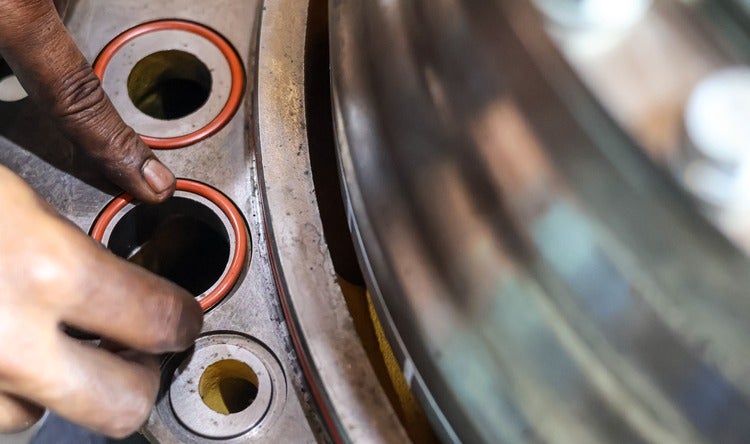
Square rings share the same familiar torus shape as O-rings but with one key difference: a flat, square cross-section instead of a round one. That geometry change gives them more sealing surface area, better resistance to rolling and twisting, and strong performance under high-pressure static loads — often making them a direct, drop-in upgrade over a standard O-ring with no groove redesign required. This article covers how square rings are constructed, when they outperform O-rings, material options, and what to watch out for in installation and service.

<style> /* Excerpt should look normal wherever it appears (listing/snippets) */ .as-blog-excerpt{ margin: 0 0 0.75rem !important; color: #555 !important; font-size: 1rem !important; line-height: 1.5 !important; } </style> <script> (function(){ // Single blog post pages in your setup look like: // /blog/view/index/id/28 // We hide the excerpt ONLY on those pages (so it still shows on blog listing pages). var path = (location.pathname || "").toLowerCase(); var isSinglePost = path.indexOf("/blog/view/index/id/") !== -1; if (!isSinglePost) return; var nodes = document.querySelectorAll(".as-blog-excerpt"); for (var i = 0; i < nodes.length; i++){ var el = nodes[i]; el.style.display = "none"; el.style.height = "0"; el.style.margin = "0"; el.style.padding = "0"; el.style.overflow = "hidden"; el.setAttribute("aria-hidden", "true"); } })(); </script>
<style> :root { --as-green: #1f7a3a; --as-green-soft: #e4f3ea; --as-text-main: #222222; --as-text-muted: #555555; --as-border-soft: #dde3df; } /* Page title (Magento native Content Heading field) */ .page-title-wrapper { text-align: left !important; margin: 1.25rem 0 1.05rem !important; } .page-title-wrapper .page-title { margin: 0 !important; font-size: clamp(2.35rem, 3.2vw, 3.45rem) !important; line-height: 1.12 !important; font-weight: 900 !important; color: var(--as-text-main) !important; position: relative; display: inline-block; padding-bottom: 0.6rem; text-transform: none !important; letter-spacing: normal !important; } .page-title-wrapper .page-title::after { content: ""; position: absolute; left: 0; bottom: 0; width: 110px; height: 3px; background: var(--as-green); border-radius: 999px; } /* Blog post title (Epicor blog module) */ h3.blog-full-title { margin: 0 0 0.85rem !important; font-size: clamp(2.35rem, 3.2vw, 3.45rem) !important; line-height: 1.12 !important; font-weight: 900 !important; color: var(--as-text-main) !important; position: relative !important; display: inline-block !important; padding-bottom: 0.6rem !important; text-transform: none !important; letter-spacing: normal !important; } h3.blog-full-title::after { content: "" !important; position: absolute !important; left: 0 !important; bottom: 0 !important; width: 110px !important; height: 3px !important; background: var(--as-green) !important; border-radius: 999px !important; } /* Featured image */ .blog-full-image { margin: 1.15rem 0 2rem; } .blog-full-image img.blog-full-img { display: block !important; width: 100% !important; max-width: 700px !important; height: auto !important; border-radius: 14px !important; border: 1px solid rgba(221,227,223,0.95) !important; box-shadow: 0 8px 22px rgba(0,0,0,0.03) !important; } @media (max-width: 640px) { .blog-full-image { margin: 0.95rem 0 2.25rem; } .blog-full-image img.blog-full-img { max-width: 100% !important; border-radius: 12px !important; } } /* Core body typography */ .as-blog-body { max-width: 860px; font-size: 1.15em; line-height: 1.65; color: var(--as-text-main); } .as-blog-body p { margin: 0 0 1.1rem; } /* Section headings — scoped to body only, does NOT affect CTA block */ .as-blog-body h2 { margin: 1.55rem 0 0.65rem !important; font-size: 2.15rem !important; font-weight: 800 !important; color: var(--as-text-main) !important; position: relative !important; display: inline-block !important; padding-bottom: 0.32rem !important; text-transform: none !important; letter-spacing: normal !important; } .as-blog-body h2::after { content: "" !important; position: absolute !important; left: 0 !important; bottom: 0 !important; width: 40px !important; height: 2px !important; background: var(--as-green) !important; border-radius: 999px !important; } /* Lists */ .as-blog-body ul { margin: 0.35rem 0 1.2rem 1.15rem; padding: 0; } .as-blog-body li { margin: 0 0 0.4rem; } .as-blog-body li::marker { color: var(--as-green); } /* Links inside body */ .as-blog-body a { color: var(--as-green); font-weight: 700; text-decoration: none; border-bottom: 1px solid rgba(31,122,58,0.3); } .as-blog-body a:hover { border-bottom-color: rgba(31,122,58,0.6); } /* Dark gradient CTA block */ .as-cta-block { border-radius: 14px; background: linear-gradient(135deg, #1a2e22 0%, #1f7a3a 100%); padding: 2.75rem 2.5rem; text-align: center; margin-top: 2rem; } .as-cta-block h2 { color: #fff !important; font-size: clamp(1.5rem, 2.5vw, 2rem) !important; font-weight: 800 !important; margin: 0 0 0.6rem !important; text-transform: none !important; letter-spacing: normal !important; display: block !important; padding-bottom: 0 !important; } .as-cta-block h2::after { display: none !important; } .as-cta-block p { color: rgba(255,255,255,0.78) !important; line-height: 1.65; margin: 0 auto 0.6rem; max-width: 580px; } .as-cta-block .as-cta-contact { color: rgba(255,255,255,0.65); font-size: 0.92em; margin: 0 auto 1.75rem; max-width: 580px; } .as-cta-block .as-cta-contact a { color: rgba(255,255,255,0.90) !important; font-weight: 700; text-decoration: none; border-bottom: none; } .as-cta-block .as-cta-contact a:hover { text-decoration: underline; } .as-cta-block .as-cta-row { display: flex; justify-content: center; gap: 12px; flex-wrap: wrap; } @media (max-width: 640px) { .as-cta-block { padding: 2rem 1.25rem; } } /* Button system */ .as-btn { display: inline-flex; align-items: center; gap: 8px; border-radius: 999px; font-weight: 700; letter-spacing: 0.02em; cursor: pointer; text-decoration: none !important; border: 2px solid transparent; transition: box-shadow 0.15s, transform 0.15s, background 0.15s, border-color 0.15s; white-space: nowrap; line-height: 1; } .as-btn:hover { transform: translateY(-2px); } .as-btn .as-arrow { transition: transform 0.15s; display: inline-block; } .as-btn:hover .as-arrow { transform: translateX(3px); } .as-btn-sm { padding: 9px 20px; font-size: 13px; } .as-btn-md { padding: 13px 28px; font-size: 15px; } .as-btn-lg { padding: 16px 36px; font-size: 16px; } .as-btn-primary { background: linear-gradient(135deg, #27913f 0%, #1f7a3a 55%, #185f2d 100%); color: #fff !important; border-color: transparent; box-shadow: 0 3px 12px rgba(31,122,58,0.28), inset 0 1px 0 rgba(255,255,255,0.14); } .as-btn-primary:hover { box-shadow: 0 8px 24px rgba(31,122,58,0.36), inset 0 1px 0 rgba(255,255,255,0.14); color: #fff !important; } .as-btn-primary-ondark { background: linear-gradient(135deg, #27913f 0%, #1f7a3a 55%, #185f2d 100%); color: #fff !important; border-color: rgba(255,255,255,0.20); box-shadow: 0 4px 16px rgba(0,0,0,0.25), inset 0 1px 0 rgba(255,255,255,0.14); } .as-btn-primary-ondark:hover { border-color: rgba(255,255,255,0.40); box-shadow: 0 10px 28px rgba(0,0,0,0.30), inset 0 1px 0 rgba(255,255,255,0.14); color: #fff !important; } .as-btn-ghost { background: #e4f3ea; color: #1f7a3a !important; border-color: rgba(31,122,58,0.28); box-shadow: none; } .as-btn-ghost:hover { background: #cce8d6; border-color: rgba(31,122,58,0.50); color: #1f7a3a !important; } .as-btn-frosted { background: rgba(228,243,234,0.15); color: #fff !important; border-color: rgba(228,243,234,0.45); box-shadow: none; } .as-btn-frosted:hover { background: rgba(228,243,234,0.25); border-color: rgba(228,243,234,0.75); color: #fff !important; } </style> <div class="as-blog-body"> <p>A square ring is a sealing device with the same overall torus shape as an O-ring — circular when viewed from above — but with a flat, square cross-section instead of a round one. That single geometric difference changes how the seal contacts its mating surfaces, how it behaves under pressure, and where it performs best. Square rings are commonly used in static sealing applications where their flat profile provides more contact area, better groove stability, and stronger resistance to extrusion than a round O-ring of comparable size.</p> <p>They're also known by several other names: washer rings, lathe-cut rings, and square-cut seals are all the same thing. They are <em>not</em> the same as X-rings or quad rings — a distinction worth clarifying upfront, since the terms get confused. More on that below.</p> <h2>Construction and Cross-Section Geometry</h2> <p>Where an O-ring has a circular cross-section, a square ring has four flat faces. When seated in a groove and compressed, those flat faces contact the groove floor and the mating surface across their full width — creating a broader sealing interface than a round cross-section would. The material is homogenous with no joints or laminations, and tolerances on cross-section, inner diameter, and outer diameter are held tightly.</p> <p>Square rings follow the AS568 standard for inside diameter, making them interchangeable with O-rings size for size. However, the cross-section dimension is slightly smaller than the corresponding AS568 O-ring. The chart below shows the square ring cross-sections for each AS568 series:</p> <table style="width:100%; border-collapse:collapse; margin: 0.5rem 0 1.5rem; font-size: 0.97em;"> <thead> <tr style="background:#1e3a5f; color:#fff;"> <th style="padding:11px 14px; text-align:left; font-weight:700;">AS568 Series</th> <th style="padding:11px 14px; text-align:left; font-weight:700;">Cross-Section (inches)</th> <th style="padding:11px 14px; text-align:left; font-weight:700;">Cross-Section (mm)</th> </tr> </thead> <tbody> <tr style="background:#f0f4f8;"> <td style="padding:10px 14px; border-bottom:1px solid #d0dae6;">Zero Series</td> <td style="padding:10px 14px; border-bottom:1px solid #d0dae6;">0.066"</td> <td style="padding:10px 14px; border-bottom:1px solid #d0dae6;">1.67 mm</td> </tr> <tr style="background:#fff;"> <td style="padding:10px 14px; border-bottom:1px solid #d0dae6;">100 Series</td> <td style="padding:10px 14px; border-bottom:1px solid #d0dae6;">0.099"</td> <td style="padding:10px 14px; border-bottom:1px solid #d0dae6;">2.51 mm</td> </tr> <tr style="background:#f0f4f8;"> <td style="padding:10px 14px; border-bottom:1px solid #d0dae6;">200 Series</td> <td style="padding:10px 14px; border-bottom:1px solid #d0dae6;">0.134"</td> <td style="padding:10px 14px; border-bottom:1px solid #d0dae6;">3.40 mm</td> </tr> <tr style="background:#fff;"> <td style="padding:10px 14px; border-bottom:1px solid #d0dae6;">300 Series</td> <td style="padding:10px 14px; border-bottom:1px solid #d0dae6;">0.203"</td> <td style="padding:10px 14px; border-bottom:1px solid #d0dae6;">5.16 mm</td> </tr> <tr style="background:#f0f4f8;"> <td style="padding:10px 14px;">400 Series</td> <td style="padding:10px 14px;">0.266"</td> <td style="padding:10px 14px;">6.76 mm</td> </tr> </tbody> </table> <p>Standard square rings are produced at 70 Shore A hardness. Harder options (80 or 90 Shore A) are available for high-pressure applications where larger clearance gaps need to be bridged. Metric dimensions are also available for applications outside the AS568 standard.</p> <h2>Square Rings vs. O-Rings: The Practical Difference</h2> <p>Because square rings use the same groove dimensions and inside diameter as AS568 O-rings, they can replace an O-ring directly without any hardware modification. The question is whether there's a reason to make that swap.</p> <p>The flat cross-section provides a wider contact patch on both the groove floor and the mating surface. This distributes sealing load across a larger area and makes the seal more resistant to being forced into clearance gaps under pressure — a failure mode known as extrusion. The flat geometry also prevents the rolling and twisting that round cross-sections can experience during assembly or under cyclic loading.</p> <div class="as-callout"> <strong>Spiral failure</strong> is a failure mode unique to round-profile seals. It occurs when uneven friction across the inner and outer diameters of a reciprocating O-ring causes it to twist along its length, creating a corkscrew pattern of damage. Because a square ring's flat faces resist this rotational tendency, spiral failure is not a concern in square ring applications. </div> <p>Where the O-ring holds an advantage is in concentrated unit loading. A circular cross-section creates a smaller, higher-pressure contact zone — which can be beneficial in low-pressure static sealing where a tight, positive seal is the priority. Round O-rings also generate less friction in dynamic applications, making them the better choice for most reciprocating or rotating seals. Square rings are less ideal for high-speed dynamic applications; the broader contact face increases friction, and under repeated sliding motion they can generate more wear than a round profile would.</p> <p>The practical takeaway: for static or slow-motion applications — particularly where pressure is high, vibration is present, or extrusion resistance matters — square rings are a direct, no-rework upgrade. For fast reciprocating dynamics, the round O-ring or an X-ring is the better tool.</p> <h2>Square Rings vs. X-Rings (Quad Rings): Not the Same Thing</h2> <p>These two seal types are frequently confused, and it's worth being precise. An X-ring (also called a quad ring) has a four-lobed cross-section — essentially two O-rings fused together in an X or figure-8 shape. This gives X-rings two sealing contact points per side, better lubrication retention in dynamic applications, and less friction than either O-rings or square rings in reciprocating service.</p> <p>A square ring has a true flat square cross-section with no lobes. It contacts the groove and mating surface across its full face width. The two profiles solve different problems: X-rings are optimized for dynamic applications where low friction and lubrication retention matter; square rings are optimized for static applications where contact area, extrusion resistance, and groove stability matter. Both fit standard O-ring grooves, but they are not interchangeable for each other's best-fit applications.</p> <h2>Material Options</h2> <p>Square rings are available in the same elastomer compounds as O-rings. Material selection follows the same logic — temperature range, fluid compatibility, and whether the application involves any dynamic motion. The table below covers the most common options:</p> <table style="width:100%; border-collapse:collapse; margin: 0.5rem 0 1.5rem; font-size: 0.97em;"> <thead> <tr style="background:#3d3d3d; color:#fff;"> <th style="padding:11px 14px; text-align:left; font-weight:700;">Material</th> <th style="padding:11px 14px; text-align:left; font-weight:700;">Temp Range</th> <th style="padding:11px 14px; text-align:left; font-weight:700;">Fluid Compatibility</th> <th style="padding:11px 14px; text-align:left; font-weight:700;">Notes</th> </tr> </thead> <tbody> <tr style="background:#f7f7f7;"> <td style="padding:10px 14px; border-bottom:1px solid #ddd;"><strong>NBR (Nitrile / Buna-N)</strong></td> <td style="padding:10px 14px; border-bottom:1px solid #ddd;">−40°F to +250°F</td> <td style="padding:10px 14px; border-bottom:1px solid #ddd;">Petroleum oils, hydraulic fluids, fuels, water, silicone greases</td> <td style="padding:10px 14px; border-bottom:1px solid #ddd;">Most common material; cost-effective for oil and hydraulic applications</td> </tr> <tr style="background:#fff;"> <td style="padding:10px 14px; border-bottom:1px solid #ddd;"><strong>FKM (Viton®)</strong></td> <td style="padding:10px 14px; border-bottom:1px solid #ddd;">−15°F to +400°F</td> <td style="padding:10px 14px; border-bottom:1px solid #ddd;">Wide chemical resistance; fuels, oils, solvents, acids</td> <td style="padding:10px 14px; border-bottom:1px solid #ddd;">Best choice for high temperature or aggressive chemical environments</td> </tr> <tr style="background:#f7f7f7;"> <td style="padding:10px 14px; border-bottom:1px solid #ddd;"><strong>EPDM</strong></td> <td style="padding:10px 14px; border-bottom:1px solid #ddd;">−58°F to +266°F</td> <td style="padding:10px 14px; border-bottom:1px solid #ddd;">Water, steam, ozone, mild acids/alkalis; not for petroleum oils</td> <td style="padding:10px 14px; border-bottom:1px solid #ddd;">Excellent for outdoor, weathering, and water/steam service</td> </tr> <tr style="background:#fff;"> <td style="padding:10px 14px; border-bottom:1px solid #ddd;"><strong>Silicone (VMQ)</strong></td> <td style="padding:10px 14px; border-bottom:1px solid #ddd;">−67°F to +437°F</td> <td style="padding:10px 14px; border-bottom:1px solid #ddd;">Dry heat, food/medical environments; not for petroleum or steam</td> <td style="padding:10px 14px; border-bottom:1px solid #ddd;">Wide temperature range; low strength limits it to static, low-load use</td> </tr> <tr style="background:#f7f7f7;"> <td style="padding:10px 14px;"><strong>Neoprene (CR)</strong></td> <td style="padding:10px 14px;">−40°F to +212°F</td> <td style="padding:10px 14px;">Moderate petroleum resistance; ozone, UV, weathering</td> <td style="padding:10px 14px;">Good for outdoor and refrigerant applications</td> </tr> </tbody> </table> <p>NBR is the default choice for the majority of industrial hydraulic and pneumatic applications. FKM is the upgrade path when temperatures exceed NBR's range or when fluid compatibility is a concern. EPDM is the correct call for water and steam service — but keep it away from petroleum-based fluids entirely. Silicone's extremely wide temperature range is useful for static sealing in ovens, food processing, or medical equipment, but its low tensile strength makes it a poor fit anywhere meaningful mechanical load is involved.</p> <h2>Where Square Rings Are Used</h2> <p>Square rings find their strongest application in static face seals — flanges, endcaps, cylinder heads, and similar configurations where the seal sits in a groove and two flat surfaces clamp together against it. The broad contact face performs well here because the load is distributed evenly and there is no sliding motion to generate friction.</p> <p>In hydraulic systems, square rings appear in cylinder endcaps, valve bodies, and manifold face connections. The higher extrusion resistance compared to a standard O-ring makes them well-suited to high-pressure hydraulic circuits where pressure spikes are common. Injection molding equipment and industrial processing machinery use them for the same reason — continuous operating pressure and vibration that would fatigue a less stable seal profile over time.</p> <p>Aerospace hydraulic systems, landing gear assemblies, and fuel system components also use square rings where the combination of high pressure and static sealing requirements aligns with the seal's strengths.</p> <p>In all of these cases, the key qualifier is <em>static or near-static</em>. Square rings can handle slow reciprocating motion, but they are not designed for high-cycle dynamic service.</p> <h2>Failure Modes and What to Watch For</h2> <p>Square rings are a reliable seal when applied correctly. The failure modes below are not reasons to avoid them — they're conditions to design around or recognize early.</p> <p><strong>Extrusion.</strong> Under sustained high pressure, seal material can be forced into the clearance gap between mating components. This is the most common failure mode in high-pressure static sealing. The square profile is more resistant to extrusion than a round O-ring, but it is not immune. The fix is to verify that hardware clearances are within spec for the operating pressure and to use a harder durometer compound (80 or 90 Shore A) if standard 70 Shore A is marginal. Backup rings can also be added for extreme pressure applications.</p> <p><strong>Compression set.</strong> Over time and at elevated temperatures, elastomers can take a permanent set — meaning the seal compresses under load and does not fully recover when the load is removed. This reduces sealing force. Material selection is the primary lever here: NBR and FKM have better compression set resistance than silicone. Operating temperature directly affects how quickly compression set develops.</p> <p><strong>Installation damage.</strong> The flat face of a square ring is more susceptible to edge cuts than a round O-ring during installation. Sharp hardware edges, threads, or keyways can nick the seal face as it's pushed into position. Chamfered lead-ins on the hardware and lubrication at installation are standard practice and eliminate most installation damage. A nicked seal won't necessarily fail immediately, but a cut across the sealing face will propagate under pressure.</p> <p><strong>Chemical degradation.</strong> A square ring in the wrong fluid will swell, harden, or crack regardless of its geometry. Always verify material compatibility against the actual fluid — not just the fluid family. Hydraulic fluid formulations vary, and some additives affect elastomers differently than the base fluid would.</p> <h2>Groove Design and Installation</h2> <p>Because square rings share the AS568 inside diameter standard, they fit in grooves designed for standard O-rings. No retooling is required for a direct replacement. The compression target for static square ring applications is 15–30% of the cross-section, which the standard O-ring groove geometry is designed to deliver. For any slow-motion dynamic use, the compression target is lower — typically 8–15% — to reduce friction and heat buildup.</p> <div class="as-callout"> When replacing an O-ring with a square ring in an existing application, verify the groove dimensions are within tolerance before assuming the swap is straightforward. Worn grooves or non-standard groove depths can affect the achieved compression and sealing performance. </div> <p>Surface finish in the groove and on the mating face matters more for square rings than for O-rings, because the flat sealing faces contact a larger surface area. Rough surfaces that a round O-ring would bridge with its curved profile may create leak paths with a flat one. Standard recommendations call for a smooth groove surface finish, and any burrs or machining marks in the sealing area should be addressed before assembly.</p> <p>Lubrication at installation reduces the risk of cutting the seal face and helps seat the ring evenly in the groove. Use a lubricant compatible with both the seal material and the system fluid — typically a light coat of the system fluid itself works for most industrial applications.</p> </div> <div class="as-cta-block"> <h2>Need help selecting the right square ring?</h2> <p>We stock square rings in AS568 standard sizes in a number of materials, with metric dimensions available. Send us your dimensions and application details and we'll get back to you with a quote — typically within approximately one business day.</p> <p class="as-cta-contact"> You can also reach us at <a href="mailto:sales@alliedseals.com">sales@alliedseals.com</a> or <a href="tel:+18476732080">847-673-2080</a>. </p> <div class="as-cta-row"> <a href="/rfq" class="as-btn as-btn-primary-ondark as-btn-md">Request a Quote <span class="as-arrow">→</span></a> <a href="/contact" class="as-btn as-btn-frosted as-btn-md">Contact Us →</a> </div> </div>
Copyright © 2026-present Allied Seals, Inc. All rights reserved.